
The Power of Play-Based Learning: How Kids Learn Through Fun
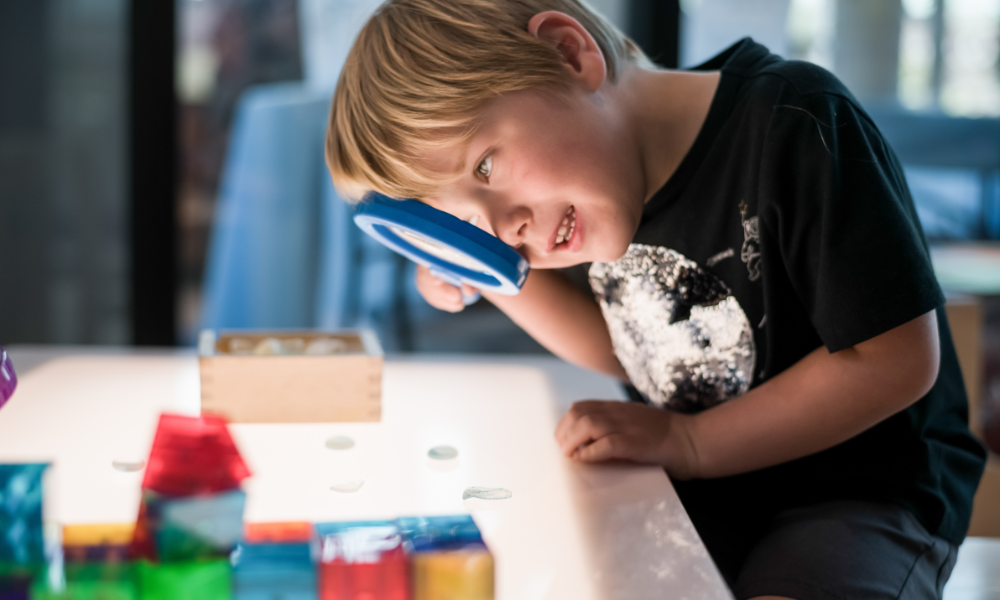
Quick Answer: Play-based learning combines child-directed exploration with intentional teaching strategies, allowing children to develop academic skills, social competence, and emotional intelligence through engaging, hands-on activities rather than traditional direct instruction.
Every parent wants their child to succeed, but what is play-based learning, and why has it become the gold standard in early childhood education? At Imagine Early Education & Childcare, we’ve witnessed firsthand how this approach transforms the way children absorb knowledge, develop crucial skills, and build confidence. When children engage in playful learning, they’re having fun while laying the foundation for academic success, social competence, and emotional resilience that will serve them throughout their lives.
Understanding Play-Based Learning in Early Education
Play-based learning represents a fundamental shift from traditional direct instruction methods. Instead of sitting passively while absorbing information, children become active participants in their own education. This approach recognizes that a young child naturally explores the world through play, making it the most effective vehicle for meaningful learning in the early years.
Key Components of Play-Based Learning:
- Active Engagement – Children learn by doing, not just listening
- Child-Led Discovery – Following children’s natural interests and curiosity
- Hands-On Exploration – Using concrete materials before abstract concepts
- Social Interaction – Learning through peer collaboration and play
- Joyful Experience – Making learning fun and memorable
- Integrated Curriculum – Blending multiple subject areas naturally
In our classrooms, children’s learning happens through carefully designed environments where free play and structured activities blend seamlessly. A child building with blocks isn’t just stacking objects; they’re exploring mathematical concepts, developing spatial reasoning, and strengthening their problem-solving skills.
The Science Behind Learning Through Play
Research in child development consistently demonstrates that play activates multiple areas of the brain simultaneously. During imaginative play, children’s neural pathways light up as they navigate complex scenarios, negotiate with peers, and solve problems creatively. This whole-brain engagement creates deeper, more lasting learning than rote memorization ever could.
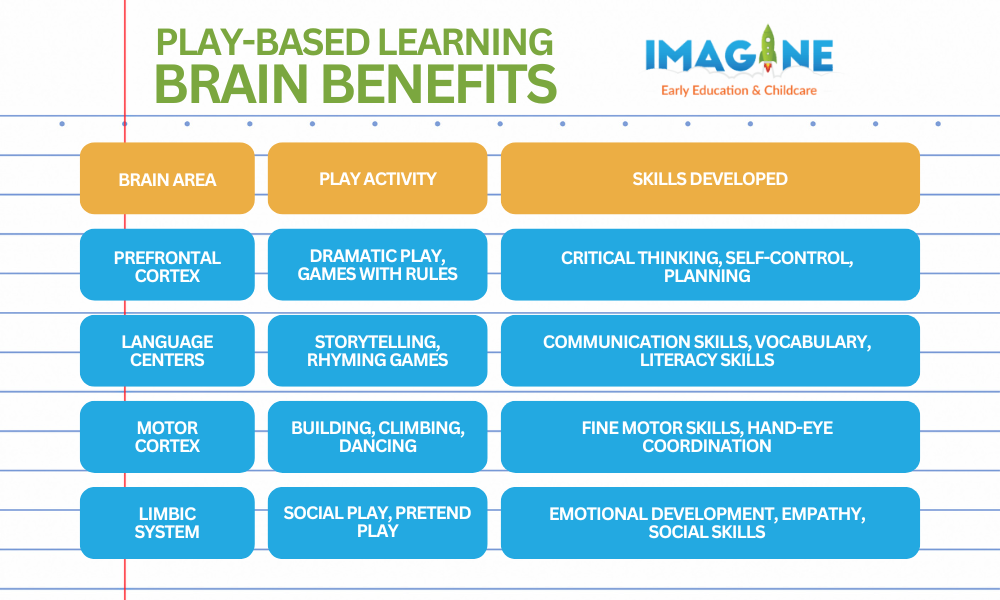
Cognitive development flourishes when children have the freedom to explore and experiment. Through playful activities, children develop critical thinking abilities as they test hypotheses, make predictions, and adjust their strategies based on outcomes.
Building Essential Skills Through Playful Activities
Social and Emotional Development
Social skills and emotional development form the cornerstone of a child’s future success, and play provides the perfect context for mastering these abilities. Through social interaction during play, children learn to share, take turns, and understand different perspectives. The kindergarten classroom becomes a laboratory for practicing interpersonal skills that will serve children throughout their lives.
When conflicts arise during play (and they inevitably do), children develop conflict resolution strategies with gentle teacher guidance. These moments become valuable learning opportunities where children practice empathy, negotiation, and compromise. Through different ways of playing together, children build self-confidence and learn to navigate the complex world of human relationships.
At Imagine Early Education & Childcare, we’ve designed our programs to foster these crucial social connections. Our educators create opportunities for collaborative play where children work together toward common goals, building friendships and learning to appreciate diversity in the process.
Physical and Motor Development
Physical development happens naturally through play, with children developing both fine motor skills and gross motor coordination without even realizing they’re “exercising.” Activities like threading beads, using scissors, or manipulating playdough strengthen the small muscles needed for writing, while running, climbing, and dancing build overall strength and coordination.
Hand-eye coordination improves through activities like catching balls, pouring water, or completing puzzles. These motor skills developments aren’t isolated physical achievements, though. They’re connected to cognitive skills and brain development. The child who struggles to hold a pencil may benefit more from playing with tweezers and pom-poms than from repetitive writing practice.
Our outdoor play spaces and indoor movement activities ensure children have ample opportunities to develop these crucial physical skills while having fun and burning energy.
Academic Readiness Through Play
Parents often worry that play-based learning might not adequately prepare children for the academic skills needed in formal schooling. However, research consistently shows that children in play-based programs perform as well as or better than their peers in traditional programs on academic measures.
Literacy skills develop naturally through play. A child “writing” a menu for their pretend restaurant is practicing pre-writing skills and understanding that print carries meaning. Story-telling during imaginative play builds narrative skills and vocabulary. Singing songs and playing rhyming games develop phonological awareness, which is a crucial precursor to reading.
Mathematical thinking emerges through block play (geometry and spatial reasoning), cooking activities (measurement and fractions), and board games (counting and number recognition). Science concepts come alive through sensory exploration, nature investigations, and cause-and-effect experiments during play.
Different Types of Play and Their Benefits
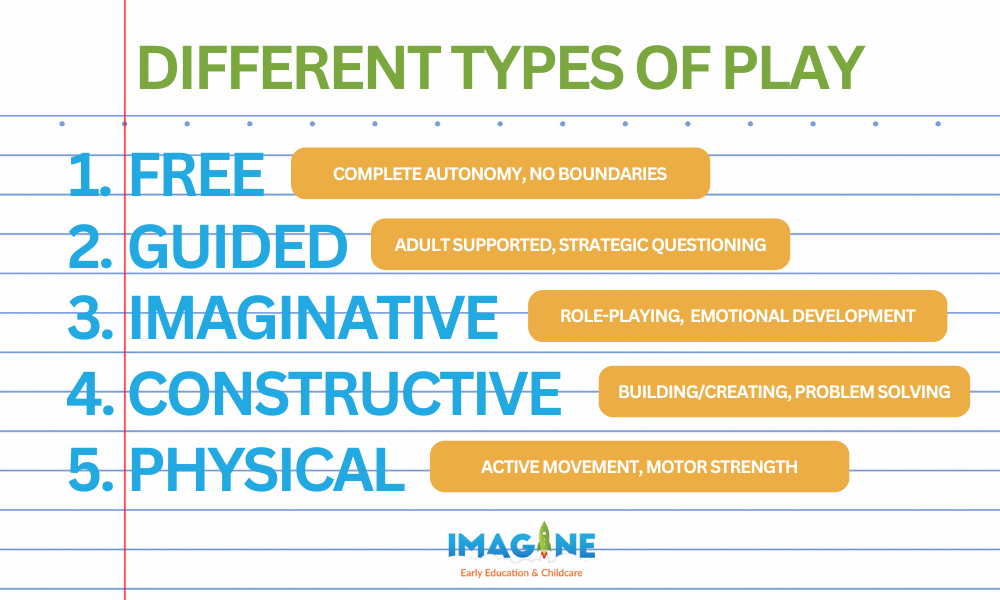
Play Categories and Learning Outcomes:
- Free Play
- Complete autonomy in activity choice
- Develops independence and decision-making
- Builds self-regulation skills
- Encourages creativity without boundaries
- Guided Play
- Adult-supported but child-led
- Extends learning through strategic questioning
- Introduces new vocabulary naturally
- Maintains child ownership of experience
- Role-playing and pretend scenarios
- Develops emotional skills and empathy
- Practices different roles in society
- Processes real-life experiences safely
- Constructive Play
- Building and creating activities
- Enhances spatial reasoning
- Develops persistence and resilience
- Strengthens problem-solving skills
- Active movement and exercise
- Builds gross motor strength
- Improves coordination and balance
- Supports overall health and wellness
Supporting Play-Based Learning at Home
Parents play a vital role in extending play-based learning beyond the classroom. Creating a home environment that values play doesn’t require expensive toys or elaborate setups. Simple materials like cardboard boxes, art supplies, and household items can provide hours of educational play.
Follow your child’s lead during play, asking open-ended questions that encourage thinking: “What do you think will happen if…?” or “How did you figure that out?” Resist the urge to direct or correct. Instead, observe and appreciate the learning that’s naturally occurring.
Set aside dedicated time for unstructured play, free from screens and scheduled activities. This downtime is when creativity flourishes and children process their learning from the day. Value this play time as much as you value homework or structured activities.
The Role of Educators in Play-Based Learning
Our educators at Imagine are trained to be both observers and facilitators of play. They create provocative environments that invite exploration, then step back to watch learning unfold. They document children’s play to assess development and plan future activities that build on emerging interests and skills.
Professional development ensures our teachers understand the latest research in early education and can articulate the learning happening within play. They help parents see that the child playing with water isn’t just making a mess; they’re exploring volume, cause and effect, and properties of matter.
Teachers also ensure that all children have access to rich play experiences, regardless of background or ability. They adapt materials and activities to meet diverse needs, ensuring every child can participate meaningfully in play-based learning.
Common Concerns With Play-Based Learning
High-quality play-based programs like ours are highly intentional. Every material, every room arrangement, and every interaction is purposefully designed to support child’s development across all domains.
Others concern themselves with kindergarten readiness, fearing their child will be behind peers from more academic programs. Research consistently shows that children from play-based programs enter kindergarten with stronger communication skills, better self-regulation, and more enthusiasm for learning. There are advantages that persist throughout their academic careers.
The key is understanding that play-based doesn’t mean “anything goes.” It’s a sophisticated pedagogical approach that requires skilled educators, thoughtful planning, and deep understanding of child development.
The Long-Term Impact of Play-Based Learning
Children who experience quality play-based early childhood education develop essential skills that extend far beyond the classroom. They become creative problem-solvers, confident communicators, and collaborative team members. These are precisely the skills employers seek in the 21st-century workforce.
The self-confidence built through successful play experiences creates resilient learners who view challenges as opportunities rather than obstacles. The social development fostered through cooperative play produces adults who can work effectively with diverse groups. The creativity nurtured through imaginative play leads to innovative thinking in adulthood.
Perhaps most importantly, play-based learning preserves children’s natural love of learning. Rather than viewing education as a chore, children from play-based programs maintain curiosity and enthusiasm for discovery throughout their lives.
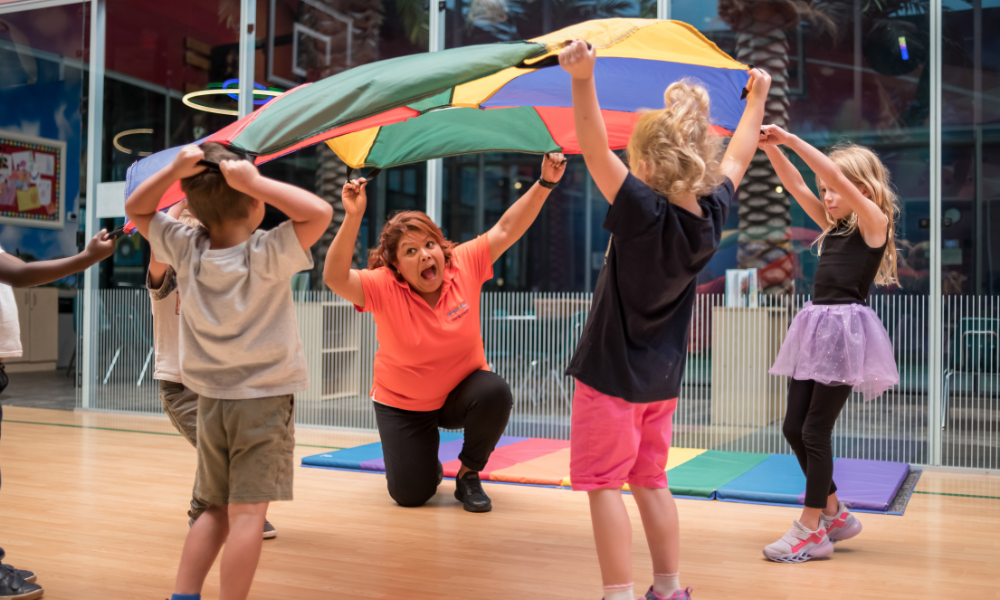
Embrace the Power of Play at Imagine Early Education
Play-based learning is a research-backed approach that honors how young children naturally learn and grow. At Imagine Early Education & Childcare, we’ve witnessed countless children blossom through our balanced approach that combines the magic of play with intentional teaching strategies.
By trusting in the power of play, we give children the gift of joyful learning. We preserve their natural curiosity while building the academic skills, social skills, and emotional development they need for success. In our classrooms, children don’t have to choose between having fun and learning. They do both simultaneously, creating memories and building foundations that last a lifetime. Contact us to learn more about our early education programs!

